From 1 July 2027, the 50 per cent capital gains tax (CGT) discount gives way to cost base indexation and a new 30 per cent minimum tax rate for individuals. The rules are not retrospective: growth built up before that date keeps the discount. Here is how the two systems compare, and who could be better or worse off.
In brief
From 1 July 2027, the 50% CGT discount is replaced by cost base indexation (tax only the gain above inflation) plus a 30% minimum tax rate on net capital gains for individuals. The change is enacted by the Treasury Laws Amendment (Tax Reform No. 1) Act 2026 and is not retrospective: growth built up before 1 July 2027 keeps the 50% discount.
Bottom line for clients: there is no need to sell early. Strong-growth assets will generally pay more tax on post-2027 growth; modest-growth assets will generally pay less. Self-funded retirees and low-income earners lose most from the 30% minimum tax.
Changes taking effect on 1 July 2027
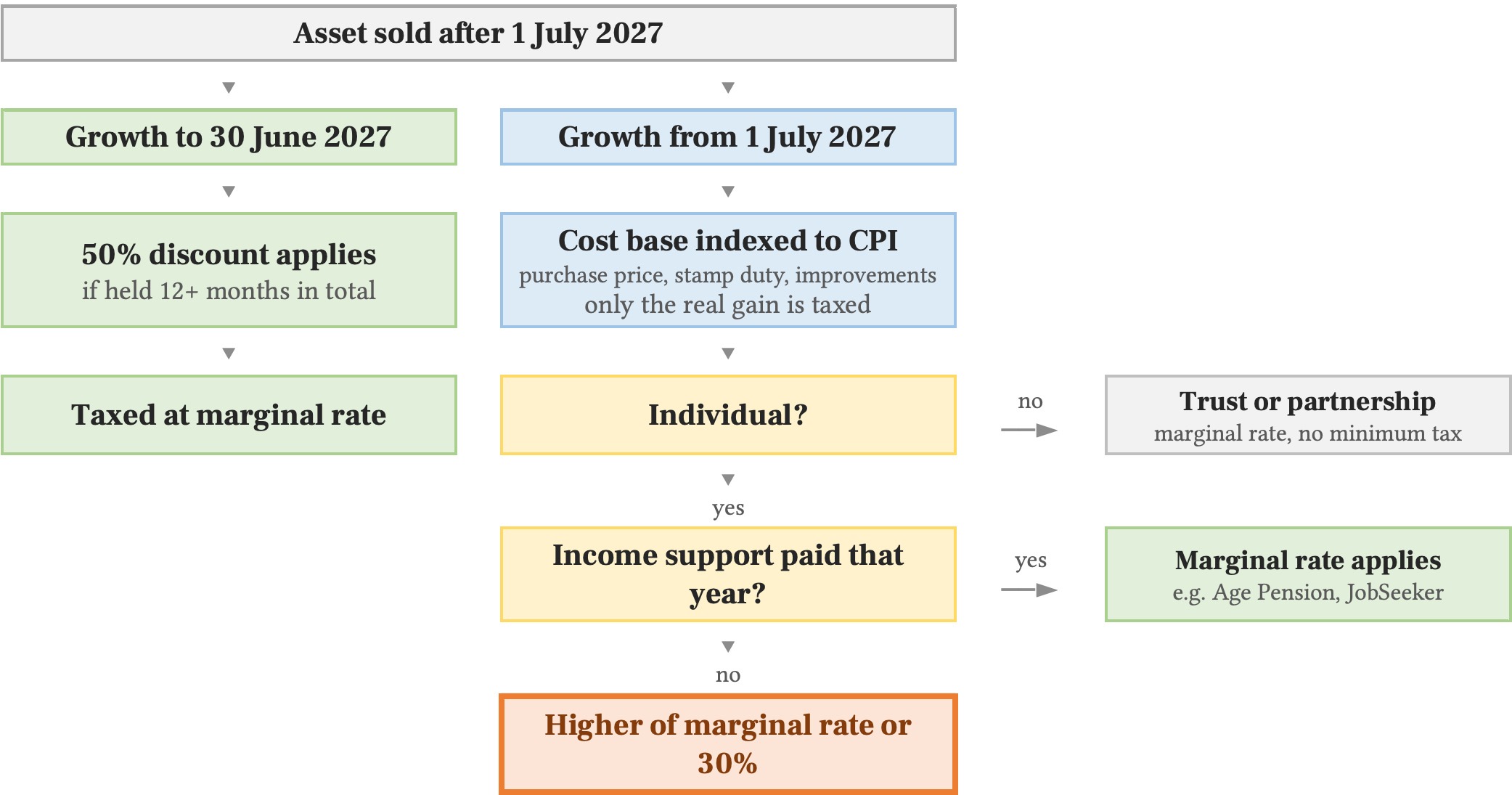
Assets held on 1 July 2027 are treated as sold and bought back at market value that day. No tax is payable then: the notional gain is deferred until the asset is actually sold. On sale, the gain is split in two:
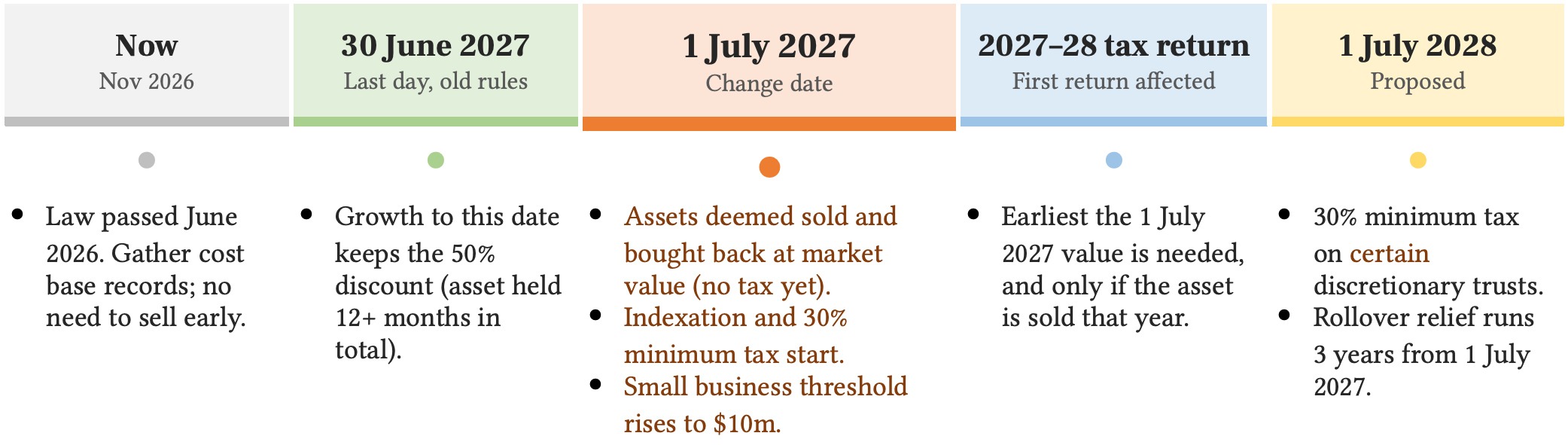
Key dates
Each sale after 1 July 2027 splits the gain in two
individuals not on income support face the 30% minimum tax.
Rules that remain unchanged
Family home: main residence exemption remains unchanged.
Super funds (incl. SMSFs): keep the one-third (33.33%) discount in accumulation phase.
New residential builds and affordable housing: eligible investors can elect to stay on the old discount (50%, or up to 60% for eligible affordable rental housing) instead of indexation and the 30% minimum tax.
Small business CGT concessions: retained. The turnover threshold for the 50% active asset reduction rises from $2 million to $10 million on 1 July 2027.
Pre-CGT assets (bought before 20 September 1985): growth to 1 July 2027 stays exempt. Future growth is taxed under the new rules.
Comparing the two systems
Feature
50% discount (gains to 30 June 2027)
Indexation (gains from 1 July 2027)
Applies to
Resident individuals, trusts, partnerships
Same; the 30% minimum tax applies to individuals only
Taxable gain
Sale price less cost base, then halved
Each cost item lifted by CPI, then subtracted from sale price
Inflation protection
None (all gain taxed)
Full CPI adjustment
Minimum tax rate
Marginal rate
Higher of marginal rate or 30% (income support recipients are exempt)
Holding period
12 months
12 months
Records needed
Total cost base
Date and amount of every capital cost, plus 1 July 2027 value
Generally better when
Growth exceeds about 2x cumulative inflation
Modest growth, or high inflation
Worked examples
Rule of thumb: if an asset’s total gain is more than about double cumulative inflation, the 50% discount gives the smaller taxable gain. Below that, indexation wins, though the 30% minimum tax can still lift the bill for lower-income individuals.
Two growth scenarios for a $500,000 investment over five years
Scenario A: strong growth
Scenario B: modest growth
Growth rate
8% a year
3.5% a year
Sale price after 5 years
$734,664
$593,843
Nominal gain
$234,664
$93,843
Taxable gain: 50% discount
$117,332
$46,922
Taxable gain: indexation (real gain)
$155,027
$14,206
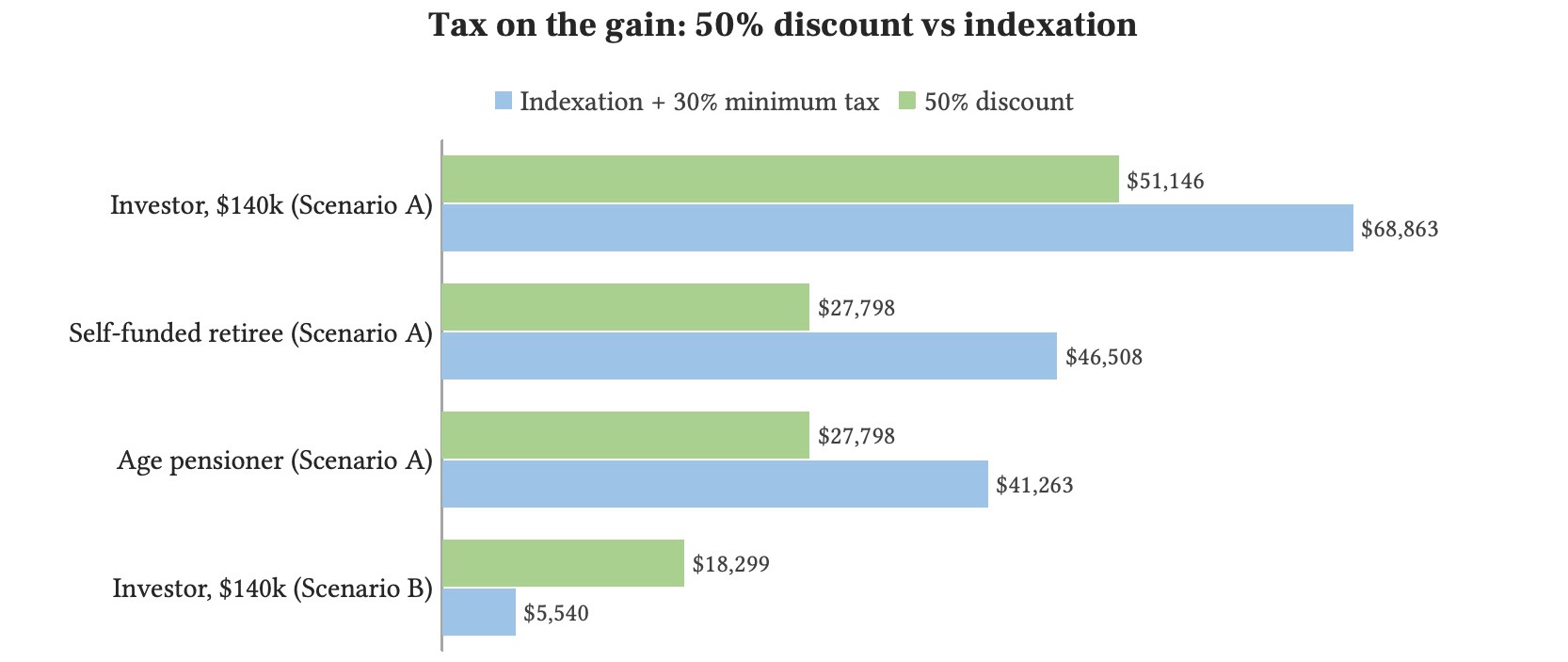
Tax for investor on $140k: 50% discount
$51,146
$18,299
Tax for investor on $140k: indexation
$68,863
$5,540
Change in tax under the new rules
+$17,717 more
$12,759 less
Article’s worked examples · pensioner difference calculated from its figures
Assumptions: $500,000 invested on 1 July 2027, held 5 years, 3% annual inflation, so the indexed cost base is $579,637. Gains sit on top of $140,000 other income for the investor and $0 for retirees (tax offsets ignored). Rates from 1 July 2027: 0% to $18,200, 14% to $45,000, 30% to $135,000, 37% to $190,000, 45% above, plus 2% Medicare levy.
The Age Pension figure ignores assessable pension income, which in practice would lift the starting point.
Benefits and drawbacks of each method
50% CGT discount
Cost base indexation (from 1 July 2027)
Pros
Simple: subtract costs, halve the profit, no CPI tables.
Generous in strong markets: half of any gain is sheltered.
No 30% minimum tax, so low-income years are taxed at actual marginal rates.
Taxes only real gains above inflation.
Lower tax when inflation is high and growth is weak; can reduce a gain to zero.
The tax-free buffer grows the longer a steady asset is held.
Cons
Taxes “phantom” inflation gains.
A 13-month flip gets the same discount as a 20-year hold.
Much higher tax on strong performers (growth above about 2x inflation).
Heavier records, and possibly a formal valuation at 1 July 2027 for property, private companies or trusts.
Self-funded retirees and low earners lose the benefit of lower brackets.
Cannot create or increase a capital loss.
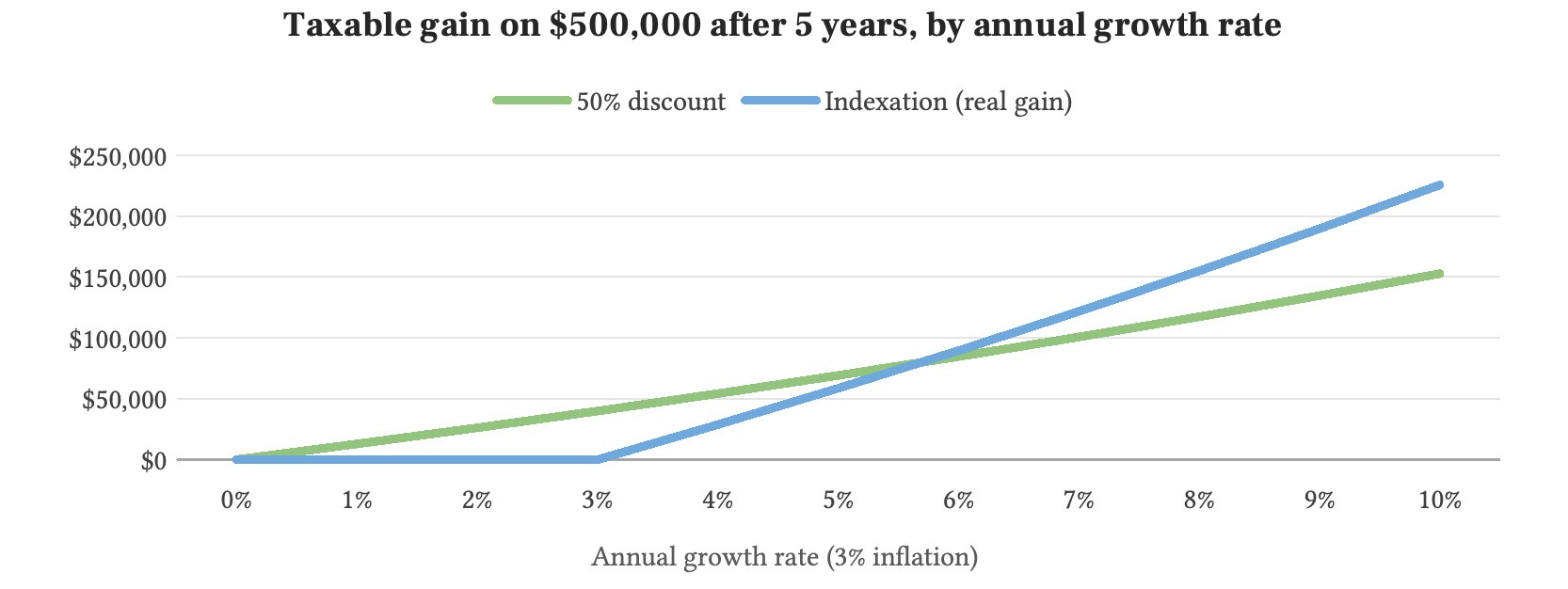
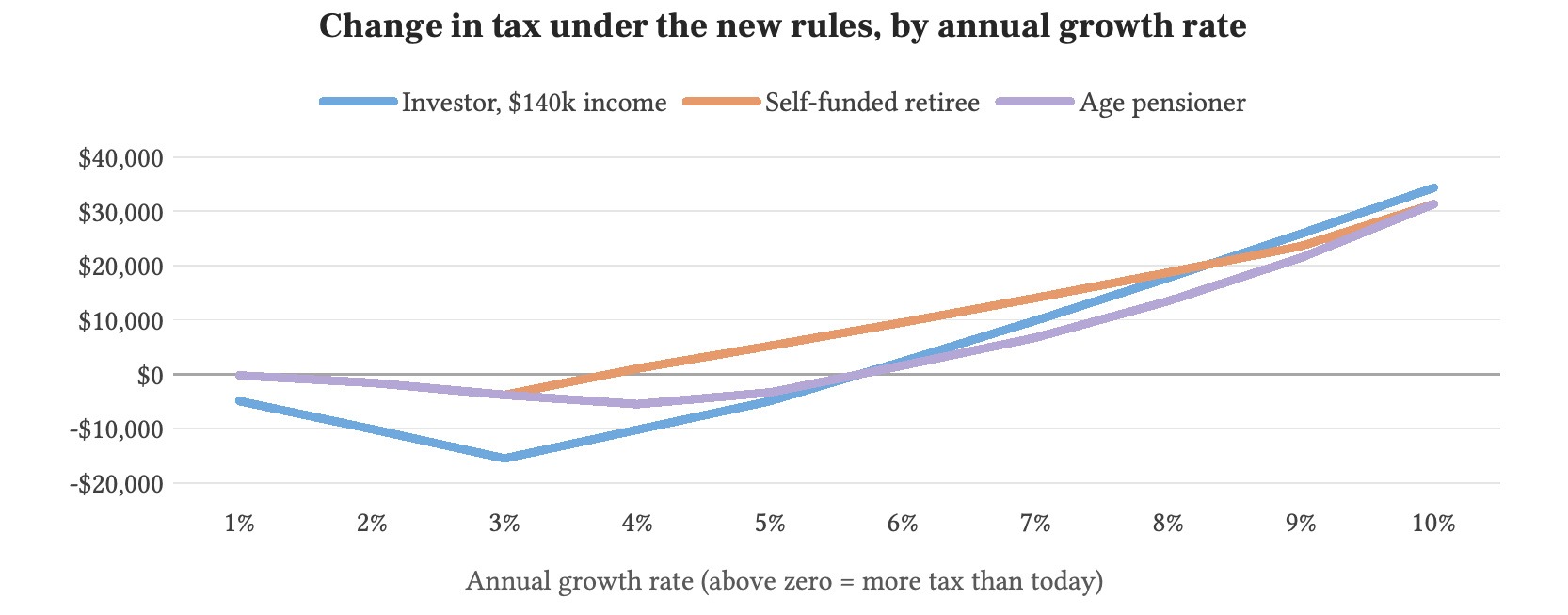
Where the lines cross: at about 5.7% growth a year, total growth (about 32%) is double cumulative inflation (about 16%). Below that, indexation taxes less; above it, the 50% discount taxes less.
Calculated using the article’s assumptions: $500,000 invested 1 July 2027, 3% inflation, sold after 5 years
Practical steps before 1 July 2027
With over seven months to go, clients have time to prepare rather than rush.
☐ Don’t sell just to lock in the 50% discount. Pre-2027 growth keeps it anyway. Selling early brings forward the tax bill, adds brokerage or stamp duty, and loses future compounding on the tax paid.
☐ Gather cost base records: purchase contracts, settlement statements, brokerage receipts and capital improvement invoices, so pre- and post-2027 gains can be separated cleanly.
☐ Plan for the 1 July 2027 value. Listed shares and ETFs have market prices. Property and private business assets can be valued at the time of sale, or under an apportionment method the Government is still developing. The value isn’t needed until the 2027–28 return at the earliest.
☐ Review ownership structures. A separate 30% minimum tax on certain discretionary trusts is proposed from 1 July 2028. Draft law offers three years of rollover relief from 1 July 2027 to restructure, or an election to stay outside the minimum tax. Primary production income and fixed trusts are excluded.
Strategy options for clients
Where a client lands depends on two things:
how fast their assets are likely to grow, and
their tax position when they sell.
How growth and tax rates affect clients
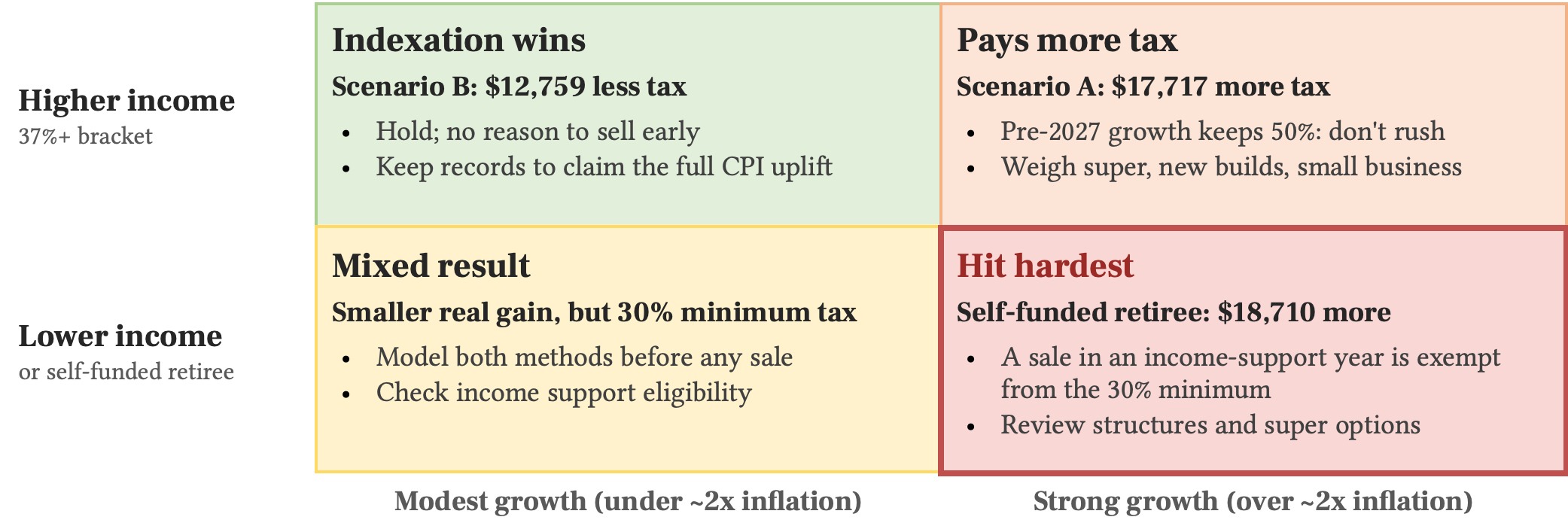
Client positioning · figures from the article’s worked examples
When each client starts paying more: self-funded retirees from about 4% growth a year (because of the 30% minimum tax); investors and Age pensioners from just under 6%. Below those rates, the new rules cost less.
Calculated using the article’s assumptions and tax rates; Age pensioner excludes assessable pension income and offsets
Planning options to discuss
Timing: pre-2027 growth is protected, so selling early rarely helps. The income support exemption applies year by year, so the timing of a sale can matter for retirees.
Where assets sit: super keeps a one-third discount. New builds and affordable housing can elect the old 50% (up to 60%) discount. Small business concessions now reach businesses with up to $10 million turnover.
Asset mix: steady assets growing at under about twice inflation are favoured by indexation. High-growth assets carry more post-2027 tax.
Structures: review discretionary trusts before the proposed 1 July 2028 trust minimum tax, using the rollover window from 1 July 2027 if needed.
General information only; it does not account for any client’s personal objectives, finances or tax position. Seek advice before acting.